
What catches your imagination?
The villain?
The tricksters?
Or maybe both?
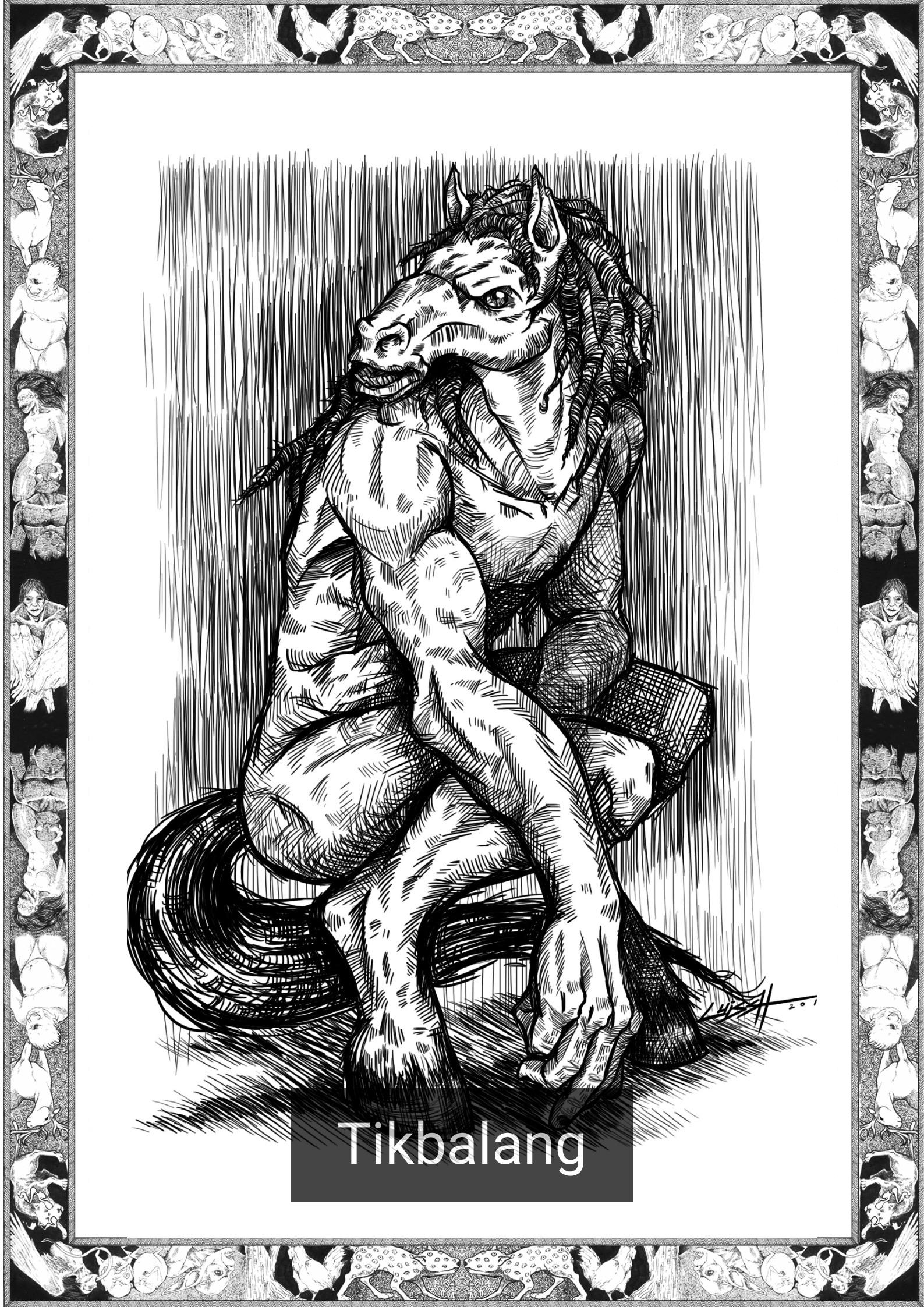
One halimaw that lives in the thoughts of those that live in Tagalog lands is the Tikbalang, though that is not the full extent of their territory.
Women beware!
There have been documented cases of the Tikbalang abducting your kind.
Hundreds of years have passed but the night of April 15, 1580 still sends a chill down the spines of those that know the story.
Her name is lost to time, and sorrow follows her tale.
It was not complicated, no wooing or courting.
She was abducted by the Tikbalang.
And then she was killed.
They could only describe the creature as thus:
“Tall and horrific, dressed in a tunic as dark as night. Its hair flowed over its shoulders and its legs were like that of a horse.”
In those times intellectual pursuits were under the purview of the church.
Yet was it demonized?
Or was the Tikbalang already a demon?
Another tale of old focuses on an Augustinian priest from Calumpit.
He says of the Tikbalang:
“It is a ghost that appears in the form of an eldritch beast that causes its victims to do things against their religion.”
It is true that fear follows that Tikbalang, but its origins speak through centuries with our neighbors.
Trade was the lifeblood of the islands, and it is because of that, that an old god deigned to be know.
Hayagriva.
The horse.
The animals were assimilated in the archipelago.
It was centures, 900 years before the falling of the Spaniards that merchants from China plied their wares. Among them, the beasts of burden. Horses.
It is hypothesized that this was the start of the being we know as the Tikbalang.
The name itself has may answers.
Some say it is an onomatopoeia. That, should you befriend one, they will make a ‘Tik’ sound. And the word ‘Balang’ means ‘wild’.
The veracity of that is still under debate.
There is other literature that, since horses were present when the conquistadores colonized the islands, the half horse being was told of in stories to inspire fear in the indios.
Trickster to some, guardian to others.
Among those in the province of Rizal, the Tikbalang are protectors of hidden kingdoms.
Trees are entrances to their realm and it is said that they would guard the arbors and bestow curses to those stupid enough to test their patience.
Though it is not to say there was no osmosis of thought from the Spaniards. In beliefs of those from Spain, when a witch is about to be wed, it rains on a sunny day, a story they connected to the Tikbalang. If it rains while the sun is out it is said that the horse creatures are getting married.
The Tikbalang are said to have many forms. Some to seduce, others to escape.
Their malevolence knows no bounds, raining down rocks and sicknesses to those unlucky enough to be their victims.
In legend there are even Tikbalang that show themselves to their quarry and say ‘You will die on this road’, leaving the human to wander their territory until death.
Villain?
Or trickster?
That is for you to decide.
Written by Karl Gaverza
Copyright © Karl Gaverza
Inspired by the Tikbalang Legends
Tikbalang Illustration by Mark Luis Hernandez
